


The Tungsten Tail Project.
A past-producing scheelite property in Sierra County, New Mexico, with historic high-grade workings and no recorded drilling. Gordon plans to be the first to drill it.

A historic tungsten-producing mine with untapped, undrilled potential.
Five things investors should know about Tungsten Tail.
Tungsten is a defence-critical metal with no substitute.
Nothing else combines tungsten's density, hardness and 3,400 °C melting point. It is what armour-piercing munitions, armour plate, aerospace parts and the cutting tools that machine them are made from. The United States lists it as a critical mineral, defence demand is being brought back onshore, and the country has had no domestic primary tungsten production for years.
China controls the supply, and is tightening it.
China produces roughly four fifths of the world's tungsten and in 2025 placed export controls on tungsten products. Western governments, defence primes and tool makers are actively looking for North American sources. A tungsten project on US federal land, in a mining-friendly state, sits squarely in that gap.
A past-producing mine that has never been drilled.
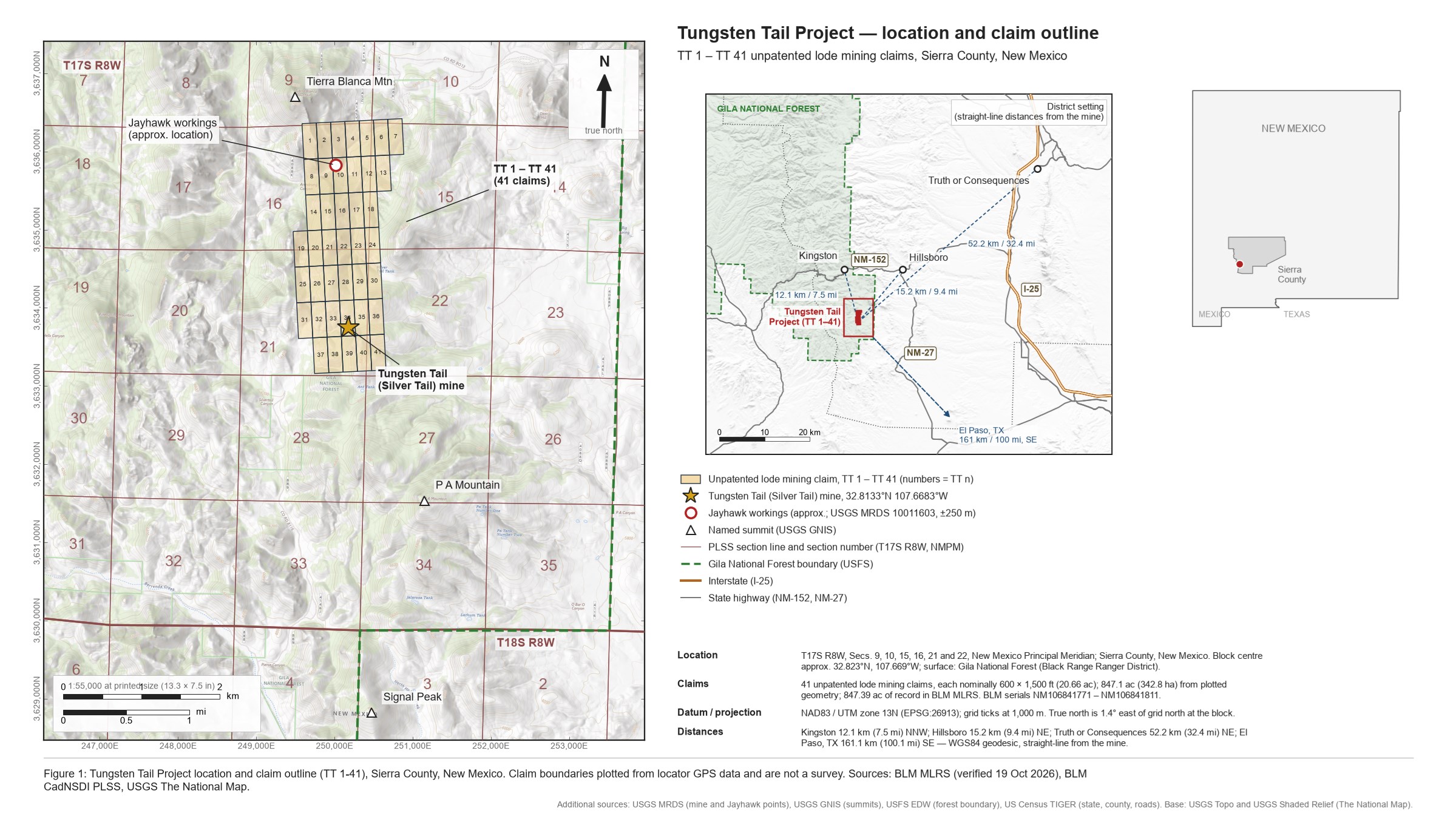
Tungsten Tail shipped scheelite ore in 1942 and 1955, with historical grades reported at roughly 3–4% WO3, and more than 300 m of underground workings were developed. The Company has found no record of a single drill hole on the project. The 41 claims cover the mine itself and part of the Pierce Canyon fault, which was never followed at depth.
A district-scale target already flagged by the USGS.
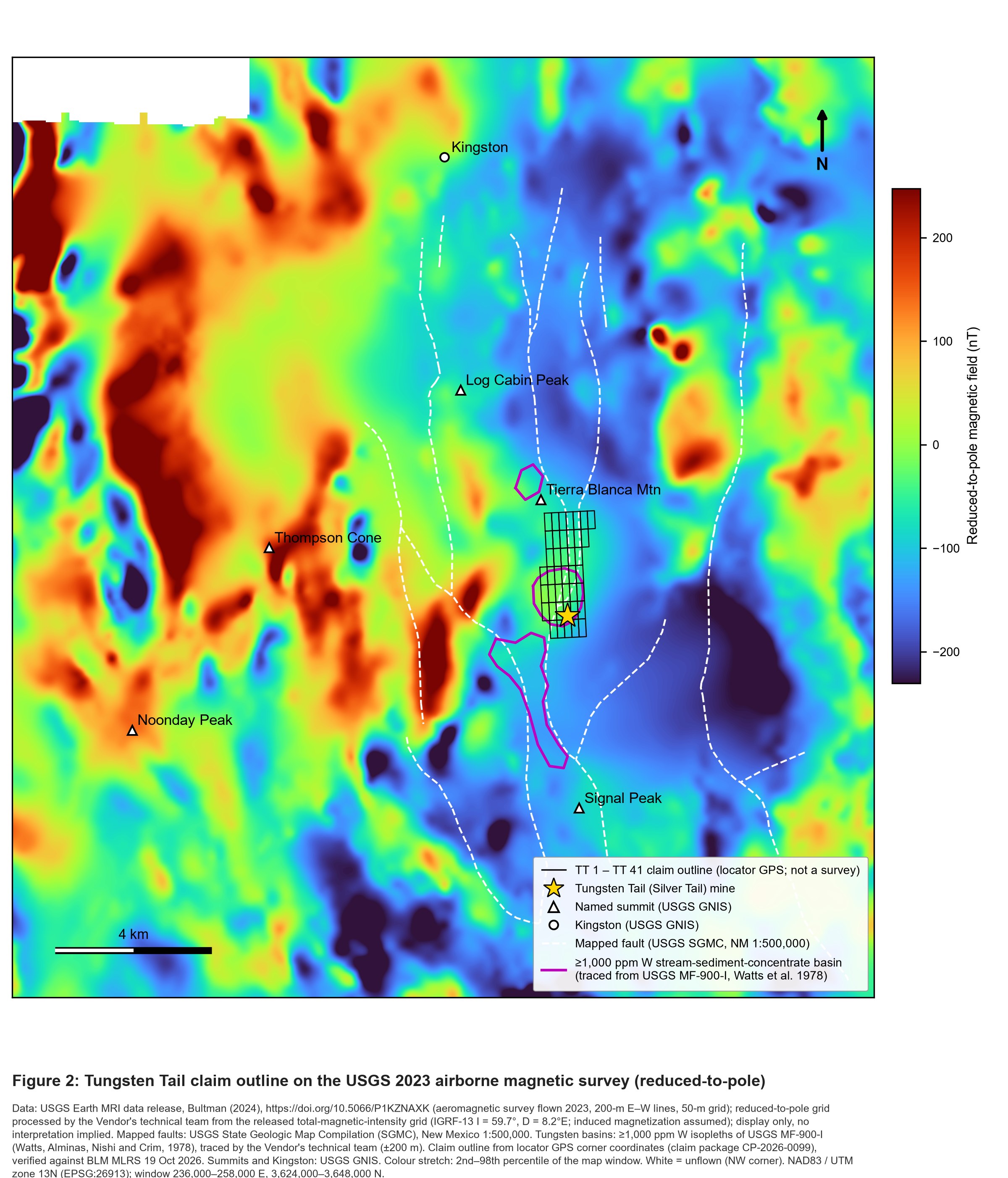
USGS stream-sediment surveys from 1977–81 traced anomalous tungsten along the Pierce Canyon fault corridor and described it as a target for deposits at depth. A 2023 USGS airborne magnetic and radiometric survey covers the whole project and has never been interpreted. Our model targets scheelite along the fault, possibly fed by skarn beneath the Percha Shale.
AI-driven exploration, paid for by milestones.
Gordon will apply AI-assisted targeting to the historical records, the USGS geophysics and new mapping, UV scheelite surveys and sampling to define the project's first-ever drill targets. Acquisition payments are staged against drill permits, a first drill program and a resource milestone, so spend follows progress rather than running ahead of it.
Historical production figures, grades and sample results are historical in nature, were not prepared under NI 43-101 and have not been verified by a Qualified Person. They are not representative of mineralization across the project and no mineral resource or reserve has been estimated.
Tungsten Tail at a glance
The Tungsten Tail Project is a 100%-owned tungsten property in the Tierra Blanca mining district of Sierra County, New Mexico, covering the historical Tungsten Tail mine (formerly the Silver Tail mine) and a portion of the Pierce Canyon fault. Gordon acquired the project through the purchase of TT Minerals LLC, announced on October 19, 2026.
Geology and mineralization
The Tierra Blanca district is underlain by Paleozoic carbonate rocks, including the Fusselman Dolomite, capped by the Percha Shale. Historical descriptions of the mine point to replacement lenses, or mantos, developed near the Percha contact. Mineralized fractures and shears carry scheelite with quartz and calcite; the main zone strikes about N10°W and dips 50–65° to the southwest, with a historically exposed ore shoot roughly 9 m long and 2.4 m wide. Rhyolite porphyry intrudes the Pierce Canyon fault zone.
Gordon's exploration model targets scheelite mineralization along the Pierce Canyon fault, possibly sourced from a skarn system at depth beneath the Percha Shale. The model is built on historical government publications and has yet to be tested by drilling.
Historical work
Selected samples collected by the U.S. Bureau of Mines in 1942 returned 1.42% and 2.91% WO3. A 1957 Bureau of Mines examination recommended further work on the property, but no drilling followed. These are selective historical samples and are not representative of the mineralization as a whole.
The Pierce Canyon fault corridor
U.S. Geological Survey stream-sediment surveys carried out between 1977 and 1981 found anomalous tungsten along the Pierce Canyon fault, with heavy-mineral concentrates ranging from 100 ppm to more than 2,000 ppm tungsten, together with weaker molybdenum and silver anomalies. The USGS described the zone as a potential exploration target for deposits at depth. No dedicated district study has been published since 1989, and a 2023 USGS airborne magnetic and radiometric survey that covers the project has not yet been interpreted.
From historical records to first drill targets
Geological mapping from the Tungsten Tail mine to the Jayhawk workings, ultraviolet scheelite mapping, channel sampling of the historical workings, and rock and soil geochemistry along the fault corridor.
Ground magnetic surveys followed by induced-polarization/resistivity or CSAMT surveys, integrated with the 2023 USGS airborne data and AI-assisted targeting to image the fault and any skarn at depth.
Drill permit applications to the U.S. Forest Service and the State of New Mexico, leading to the project's first drill program. Drill targets have not yet been defined.
Qualified Person. The technical information on this page was reviewed and approved by Robert Cinits, P.Geo., a Qualified Person as defined by National Instrument 43-101. Mr. Cinits has not visited the project and has not verified the historical data.
Historical data. Historical production, grades, sample results and geochemical values referenced on this page are historical in nature, were not prepared in accordance with NI 43-101 and have not been verified by a Qualified Person. The Company has not yet carried out exploration or verification work on the project, and no mineral resource or mineral reserve has been estimated. Figures are reproduced from the Company's news release of October 19, 2026.
Five Reasons the world needs more tungsten
Stay up to date with gordon
Subscribe for updates on our projects, partnerships and investor news.